
26 July 2026 · 5 min read
Beech Wood Dowel Pins: A Practical Guide to Fluted Dowels for Cabinet and Furniture Joinery
Dowel pins do the quiet structural work in cabinets, wardrobes, drawers and frame joinery. Get them right and the joint stays square and rigid for the life of the piece. Get them wrong and the door starts to sag in a season, the drawer front works loose, the panel gaps. Two things decide whether you get them right: the wood the dowel is made from, and whether it has flutes.
Why beech over softwood
Cheap dowel pins are turned from softwood (usually pine) because it is easy to machine. Softwood dowels compress under clamp pressure, which is what makes them fit even a slightly-off drilled hole; but that same compression is why they loosen over time as the surrounding wood expands and contracts with humidity.
Beech is a dense European hardwood at around 720 kg/m³, roughly twice as dense as pine. It resists that compression, so the fit stays tight over years of seasonal movement. That is why furniture-grade joinery specifies beech dowels.
What the flutes actually do
A smooth-sided dowel forced into a glue-filled hole traps most of the glue at the bottom of the hole, where it does nothing structural, and squeezes very little onto the walls of the joint where it matters. The pin also acts like a piston and can blow the workpiece apart if the hole is a whisker undersized.
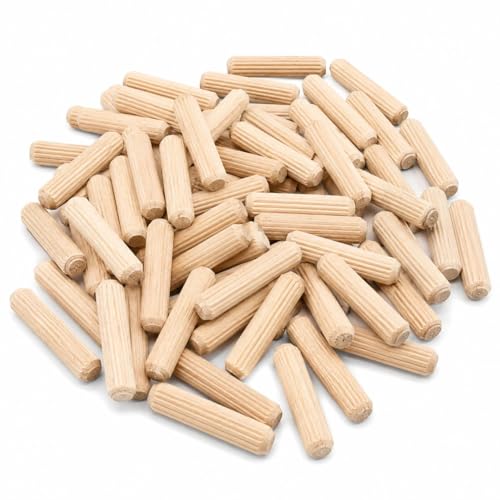
Fluted dowels solve both problems. The straight grooves channel glue evenly along the full length of the joint, and excess glue and air escape up the flutes as the pin seats. You end up with even, gap-free coverage on every millimetre of contact, and no hydraulic surprises.
Picking the size
Rule of thumb: dowel diameter roughly one third of the panel thickness. For 18 mm melamine or MDF panels, that is 6 mm dowels; for 25 to 30 mm hardwood tops or drawer fronts, 8 mm; for heavy 40 mm+ oak or beech frames, 10 mm. Length: at least 2.5 times the diameter into each half of the joint (so 30 to 40 mm dowels for typical panel work).
The stocked SKUs cover the four everyday sizes: 6×40, 8×30, 8×40, and 10×40 mm. Every pin is chamfered at both ends so it slides into a drilled hole without splitting the surrounding grain, and precision-milled to consistent diameter so the same drill bit works for every joint.
A word on drilling
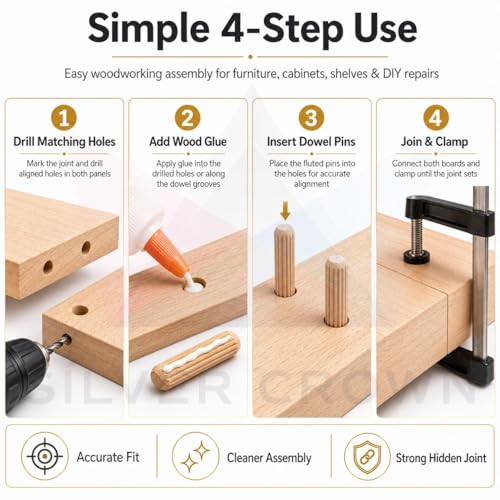
Match the drill bit to the dowel diameter (a 6 mm dowel wants a 6 mm bit, not 6.5). Drill a hair deeper than half the dowel length into each part so the pin bottoms out with a little clearance. Use a dowelling jig for anything that needs to align two panels precisely; freehand drilling on cabinet work is how you get gaps at the joints.
Ordering
SILVER CROWN beech dowel pins are stocked in 6×40, 8×30, 8×40 and 10×40 mm, in 50-piece and 200-piece packs, in Deira for pickup or UAE delivery. Message the counter with the size and quantity for a quote; workshop bulk pricing available.
Browse our plywood, mdf & timber range.