
26 July 2026 · 6 min read
Euro Cylinder Locks in the UAE: A Landlord's and Homeowner's Guide to Sizing, Fitting and Choosing the Right Cylinder
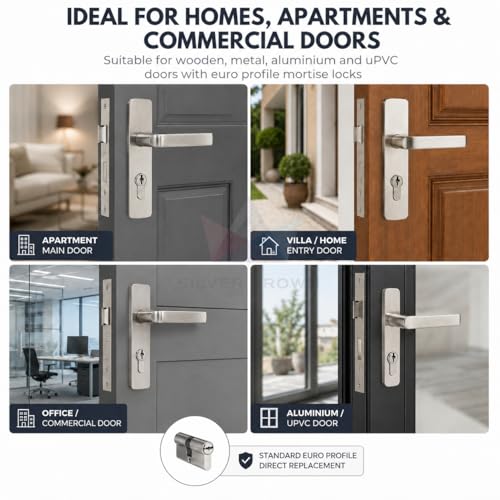
Most residential and commercial doors across the UAE, whether wooden villa doors, aluminium apartment entries or uPVC balcony doors, use a euro profile mortise lock body with a removable cylinder. When the key gets sticky, or a tenant moves out, or an owner wants to add a lockable second key set, only the cylinder needs to change. The lock body stays put, the handle stays put, no carpentry required.
How to measure your cylinder (this is where people get it wrong)
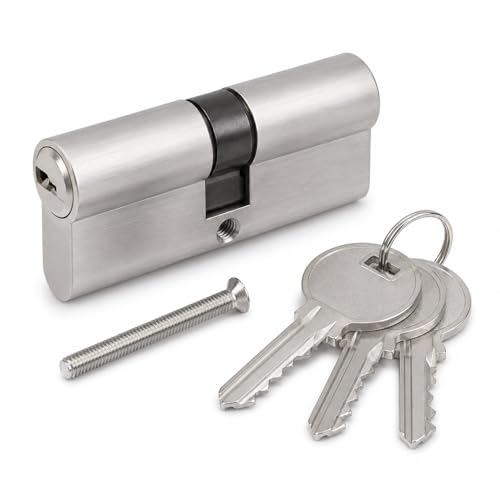
Every euro cylinder has a fixing screw hole in the centre of its faceplate. That hole is your reference point. Measure from the screw hole to one outer end (call it A), then from the screw hole to the other outer end (call it B). Add the two: A + B = your total cylinder size. For a symmetric cylinder that comes out to something like 35 + 35 = 70 mm.
Available sizes in the SILVER CROWN range: 54, 60, 70, 80, 90, 100 and 120 mm. If your measurement falls between two sizes, always choose the larger. A cylinder that is a few millimetres too long is fine (it sticks out slightly, still turns, still locks). A cylinder that is too short cannot reach the cam and will not lock at all.
Key-and-key vs thumbturn: what to choose
A key-and-key (double cylinder) needs a key from both sides. That is the SILVER CROWN default: equal length on both ends, keyed both sides. It is what you want for glass-panel doors where a thumbturn could be reached through a broken pane, for fire door applications where thumbturns are restricted, and for any door where the interior side also needs to be locked when unattended.
A thumbturn variant would let you turn the interior side by hand without a key. That is more convenient inside a private residence, but it is deliberately not what this SKU is, because the safety and security use cases in UAE flats and villas skew toward equal double-sided.
Why satin nickel zinc alloy holds up
UAE conditions eat cheap door hardware. Coastal air, air-conditioning condensation on aluminium doors, and dust in the keyway all take their toll. Zinc alloy with a satin nickel (SN) polished finish is the sweet spot for cost and durability: corrosion-resistant enough for humid and coastal locations, machined precisely enough for smooth key action, and finished in a tone that matches almost every modern satin nickel or brushed chrome handle set on the market.
It will not match a solid brass antique finish. If your handle set is polished brass or oil-rubbed bronze, mixing an SN cylinder is visually loud; use a matched finish for those doors.
The five-minute swap
Unscrew the fixing screw on the door edge (usually a single screw threading up through the lock body into the cylinder). Insert your key into the old cylinder and turn it about 10 to 15 degrees; that retracts the cam so the cylinder slides out. Slide the new cylinder in with its key turned the same way, tap the fixing screw back in, remove the key, test lock-and-unlock both sides. Job done.
The only tool required is a flat-head or Phillips screwdriver, matched to whatever the door builder used originally.
Ordering
Measure your existing cylinder as above and message the counter with the size (54, 60, 70, 80, 90, 100 or 120 mm) and quantity. Each cylinder ships with three matching keys and one fixing screw. Bulk pricing for property managers ordering across multiple flats or villas.
Browse our hand tools & building hardware range.